12 Hours, 24 Minutes, and a Whole Community
Laying on my stomach in a park in Moab, Utah in September 2025, my Chromebook balanced in the dirt, I stared at a message that had just come in from my sister-in-law. “I’ll sign up for the 2026 Ottawa Full Ironman if you do.” Sweat dripped onto the keyboard as I clicked “Register.” At the time, it felt impossibly far away.
Now, standing on the shores of the Ottawa River, tri-suit zipped, surrounded by thousands of athletes, I couldn’t help but think back to that little park in Utah. It’s funny how the biggest adventures often begin in the most ordinary moments.
Ottawa absolutely came alive for Ironman weekend.
Bib pickup at Major’s Hill Park was one of those moments that reminded me this wasn’t just another race. Nestled between Parliament and the Château Laurier, the Rideau Canal and the Ottawa River,, the whole city seemed to be buzzing. Athletes wandered around looking at free samples, families posed for photos, volunteers welcomed everyone with big smiles, and excitement seemed to fill every corner.
As in every woman’s Ironman odyssey, we (me, my friend Maddy and sister-in-law Alyssa) felt proud to receive our pink swim caps in a sea of green caps. Triathlons are still a male-dominated sport, and I think there’s something special about making space for girlhood within it. Racing hard and supporting each other aren’t mutually exclusive. In fact, I think they’re inseparable.
Ironman isn’t just about the people wearing race numbers. It’s about every person filling water cups, standing in the rain, handing out bananas, ringing cowbells, fixing bikes, or waiting patiently for twelve (or seventeen) hours just to cheer for someone they love.
Community doesn’t happen by accident. It happens because people decide to show up for one another.
Race morning arrived with weather forecasts calling for torrential rain and possible thunderstorms. I don’t usually put much stock in weather forecasts. I’ll believe it when I see it.
Well…I saw it.

The day began with a 3.8 km swim.
About halfway through, maybe 1.5 kilometres in, I looked up and thought I saw lightning.
The fear that rushed through me had nothing to do with swimming.
It wasn’t fear of failing.
It wasn’t fear of the distance.
It was the sudden realization that this thing I’d spent nearly a year training for might disappear because of something completely outside my control.
I kept swimming.
One, two, three. Breath.
One, two, three. Breath.
One, two, three. Breath.
I looked up again, forcing myself to hold my head above the water just a little longer.
Then I saw it.
Not lightning.
A safety boat disappearing into the rain, its flashing lights blurred by sheets of water.
With a rush of relief, I put my head down and continued… one, two, three. Breath. One, two, three. Breath.
The swim felt fantastic. No elbows to the face. No kicks to the goggles. Just steady strokes all the way to shore.
Into transition I went.

I switched watches (because mine wasn’t going to make it through the entire event), clipped into the bike, and headed out for 180 kilometres.
The course was split into three progressively shorter loops; just under 80 km, then just over 60 km, before finishing with the final stretch home.
Everything felt smooth until around kilometre 120. I smashed into a pothole so hard I was convinced I had a flat.
I had everything I needed to fix it.
I’d practiced changing tubes.
I knew the process.
But in that moment, I wasn’t worried about the mechanics. I was worried about what it would do mentally. Sometimes the biggest obstacle isn’t the repair itself; it’s breaking your momentum.
I refused to get off my bike, and kept pedalling, gingerly looking through my legs trying to see if I had a slow leak.
Thankfully, the tire held.
As the kilometres rolled by and the skies grew darker, I found myself thinking about something I’d noticed throughout training.
Ironman can look like a sport where success belongs to whoever owns the lightest carbon wheels, the fastest aero helmet, or the most expensive race kit.
But somewhere over those 180 kilometres, I realized none of that is what gets you to the finish line.
Those things might make you a little faster.
They don’t make you tougher.
Ironman isn’t bought.
It’s endured.
You don’t need every upgrade before you begin. You need consistency. You need grit. You need perseverance. You need to keep moving when your body wants to stop.
And you need a good pair of shoes.
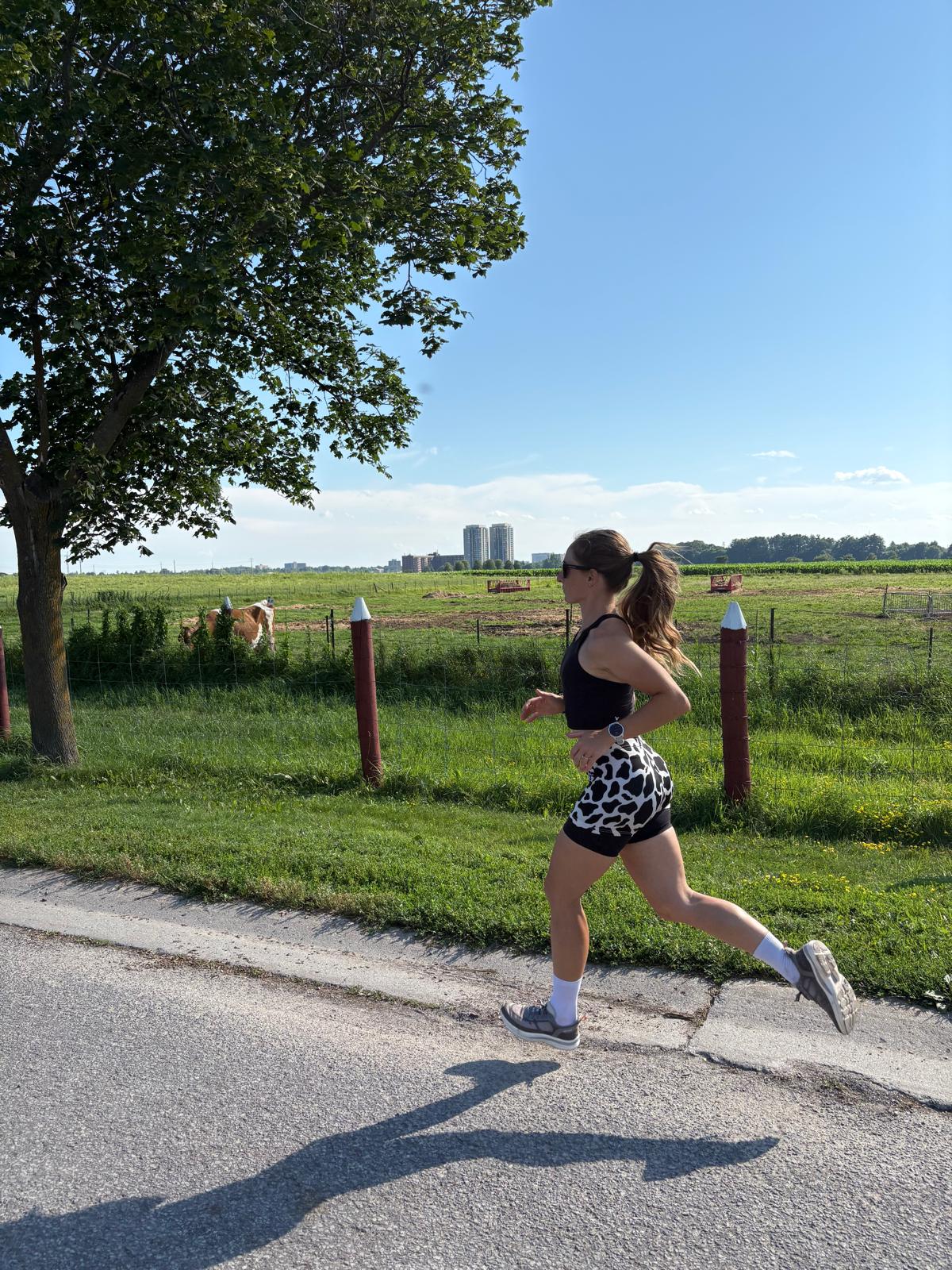
In transition zone 2, I sprayed both knees with Biofreeze, threw my Hettas on, and headed out for my first ever road marathon.
Then the skies opened. Again.
The rain became heavier. And heavier. And heavier.

Around kilometre 22 of the marathon (with “only” 19 kilometres still to go) I found myself worrying again that lightning might end the race before I could finish.
But there was nothing to do except run.
This was where my Hettas absolutely shined.
Unlike heavily cushioned shoes that seemed to soak up every puddle, the firmer sole and the mesh upper meant they didn’t absorb litres of rainwater. While runners around me could hear their shoes squishing with every stride, mine stayed remarkably light.
Instead of avoiding puddles, I just ran straight through them.
The only thing I had to watch for was what might be hiding underneath.
Every puddle could be a pothole.
Every step required a little extra attention.
Somehow, despite the weather, despite the rain, despite twelve hours of racing already sitting in my legs, the kilometres continued ticking by.
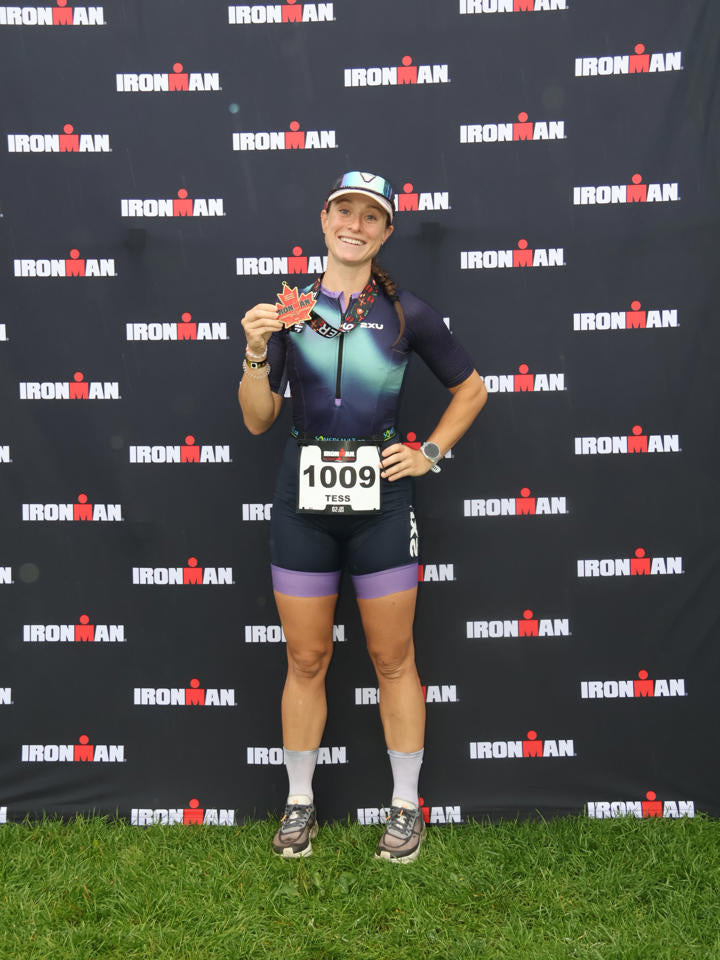
Then, after 12 hours and 24 minutes, I heard the words every Ironman dreams about.
“Tess Johnston-Iafelice… You are an Ironman!”
The finish line is impossible to describe.
Not because of the clock. Not because of the medal. Because of the people.
My friend Maddy won our age group and finished fourth overall female.
My sister-in-law Alyssa crossed the line just before me.
Several other friends absolutely crushed their races.
Nine of my friends volunteered at aid stations.
Family and friends stood in pouring rain for hours just to cheer us on.
Every time someone ran beside me for ten metres, yelled my name, offered a high-five, or simply smiled, it broke up the enormity of the day into something manageable.
Endurance sports often look like individual pursuits. They’re anything but.
An Ironman may only have one name on the results sheet, but there are dozens (or more) people hidden inside every finish.
So yes, I completed a 3.8 km swim. A 180 km bike ride. And a 42.2 km marathon.
But what I’ll remember most isn’t the distance.
It’ll be the volunteers handing me cups in the pouring rain.
The friends waiting at aid stations.
The family standing outside for hours.
The pink swim caps beside mine.
The shoes that carried me there.
The little park in Moab where this all began.
Ironman may be an individual finish line.
But it’s always a community that gets you there.